
Why Digital Marketing Matters in 2026 is a question many businesses are asking as customer behavior continues to change. A few years ago, having a website and a Facebook page was enough for many businesses to maintain an online presence. Today, customers search online, check reviews, browse social media, watch videos, and compare businesses before making a decision.
This change in customer behavior is one of the main reasons digital marketing matters more than ever in 2026.
For businesses, digital marketing is no longer just about running advertisements or posting regularly on social media. It is about being visible when customers are looking for you, giving them useful information, building trust, and making it easy for them to contact or choose your business.
Whether you run a small local business, a startup, a professional service, or an established company, your customers are already online. The real question is whether they can find your business there.
What Is Digital Marketing?
Digital marketing is simply the process of promoting a business through online channels.
It includes several different activities, such as SEO, Google Ads, social media marketing, content marketing, email marketing, website optimization, video marketing, and online reputation management.
But it is important to understand that digital marketing is not just about getting more clicks or followers.
The real purpose is to bring the right people to your business and turn their interest into something valuable such as a phone call, enquiry, appointment, purchase, or long-term customer relationship.
For example, if someone searches for “best digital marketing agency in Vijayawada,” appearing in front of that person at the right time is much more valuable than showing your advertisement to thousands of people who have no interest in your service.
That is where a good digital marketing strategy makes a difference.
Why Digital Marketing Matters in 2026 for Businesses
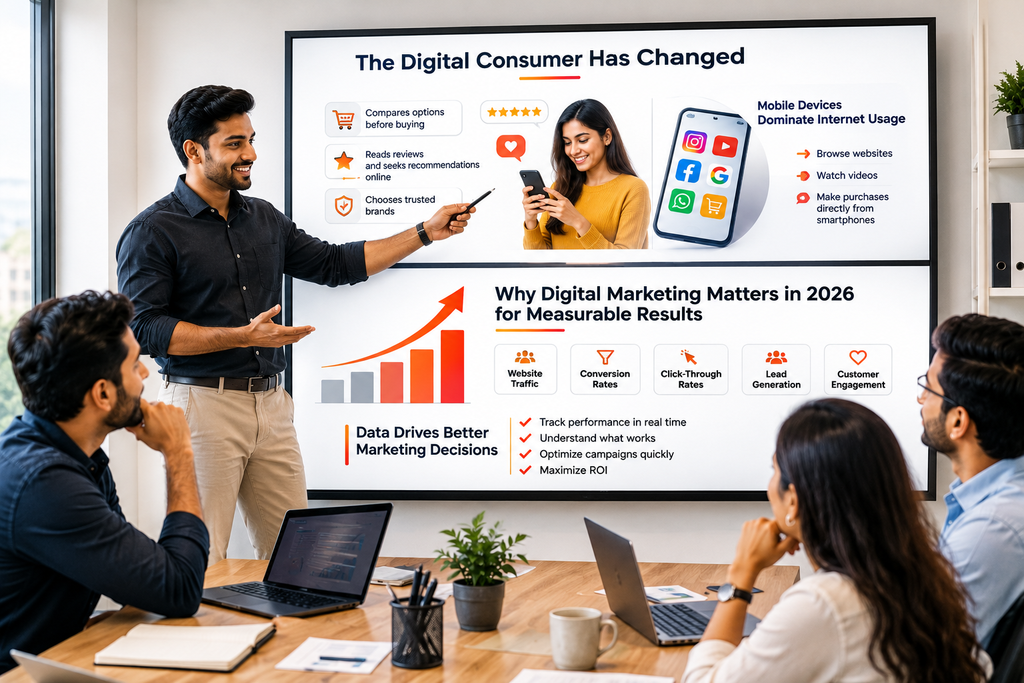
Customer behavior has changed.
People no longer depend only on recommendations from friends, newspapers, television advertisements, or traditional marketing. They have access to information instantly.
Before choosing a business, a customer might:
- Search for it on Google
- Check Google reviews
- Visit its website
- Look at Instagram or Facebook
- Compare competitors
- Watch product or service videos
- Check pricing or offers
- Read customer experiences
- Contact the business through WhatsApp or a phone call
All of these small interactions can influence a buying decision.
If your business has little or no online presence, customers may simply move on to another company that is easier to find and research.
Understanding why digital marketing matters in 2026 starts with understanding how customers make purchasing decisions today.
Understanding why digital marketing matters in 2026 starts with understanding how customers make purchasing decisions today.
Your Customers Are Already Searching Online
One of the biggest advantages of digital marketing is that it allows you to reach customers when they are actively looking for something.
Think about your own behavior.
If you need a restaurant, you probably search online. If you need a doctor, you may search for clinics nearby and check reviews. If you want to buy a product, you may compare prices and reviews before purchasing.
Your customers are doing the same thing.
This makes search marketing and SEO particularly valuable for businesses.
A business that appears when someone is searching for its products or services has a much better opportunity to attract that customer.
For small businesses, why digital marketing matters in 2026 is closely connected to visibility, trust, and the ability to reach customers without relying entirely on traditional advertising.
SEO Helps Your Business Get Found
Search Engine Optimization, or SEO, is one of the most important parts of digital marketing.
The basic idea is simple: make your website and online presence useful and relevant enough for search engines to show your business when people search for related terms.
For example, a local business may target searches such as:
- Digital marketing agency in Vijayawada
- Best salon in Vijayawada
- Dental clinic near me
- Interior designers in Vijayawada
- Real estate companies in Andhra Pradesh
Good SEO is not about repeatedly inserting keywords into a webpage.
It is about understanding what people are searching for and creating useful information that answers their questions.
SEO can take time, but the visibility it builds can continue bringing relevant visitors to your website over the long term.
Google Ads Can Help You Reach Customers Faster
SEO is valuable, but it takes time.
If a business wants to reach potential customers more quickly, paid advertising can help.
Google Ads allows businesses to appear when people search for specific products and services. Instead of waiting for someone to discover your website organically, you can place your business in front of people who are already searching.
For example, a dental clinic can run ads for people searching for dental treatments in its service area.
A real estate company can promote specific projects to people searching for properties.
A digital marketing agency can target businesses looking for marketing services.
The important thing is not simply to spend money on advertising. Campaigns need the right keywords, targeting, advertisements, landing pages, offers, and conversion tracking.
Otherwise, it is easy to spend money without knowing whether the campaign is actually generating business.
Social Media Is About More Than Followers
Social media has become an important part of how customers discover and evaluate brands.
Instagram, Facebook, LinkedIn, and YouTube give businesses a place to show what they do and how they do it.
A restaurant can showcase its food. A salon can show transformations. A hospital can share educational information. A real estate company can showcase properties. A marketing agency can share useful tips and case studies.
But simply posting every day does not guarantee results.
The content needs to give people a reason to stop, watch, read, or interact.
Sometimes that means educating them. Sometimes it means entertaining them. Sometimes it means showing your work or answering a question they have.
The goal is to build familiarity and trust over time.

People Want to Trust a Business Before Buying
Imagine that you find two businesses offering the same service.
One has a professional website, active social media pages, positive reviews, useful content, and clear contact information.
The other has an outdated website, very little information, and no recent activity online.
Which one would you feel more comfortable contacting?
This is why digital presence matters.
Customers often use your online presence as a first impression of your business.
Reviews, testimonials, social media content, website design, customer experiences, and the information you provide all contribute to that impression.
A strong digital presence does not guarantee a sale, but a poor one can certainly make customers hesitate.
Digital Marketing Helps Small Businesses Compete
One of the best things about digital marketing is that it is not limited to large companies.
A small business can build a strong online presence without having the same advertising budget as a large corporation.
For example, a local business can focus on:
- Local SEO
- Google Business Profile
- Customer reviews
- Social media
- Targeted Google Ads
- Helpful content
- Location-based campaigns
Instead of trying to reach everyone, the business can focus on the people who are most likely to become customers.
This can make digital marketing especially useful for small and local businesses.
Digital Marketing Is Measurable
Another major difference between digital marketing and many traditional forms of advertising is measurement.
When you run a digital campaign, you can see what happened.
You can track things such as:
- How many people saw the advertisement
- How many clicked
- How many visited the website
- How many filled out a form
- How many called
- How many booked an appointment
- How much each lead cost
- How many sales were generated
This information helps businesses make better decisions.
Suppose you are running two campaigns and one is generating leads at ₹300 per lead while the other is generating leads at ₹800.
You now have data that can help you decide where to improve or allocate your budget.
That is much more useful than simply knowing that an advertisement was seen by a certain number of people.
Your Website Still Matters
With so much attention on social media, some businesses forget about their website.
But your website is still one of the most important parts of your online presence.
Social media platforms are useful for attracting attention, but your website gives customers a central place to understand your business.
A good website should answer basic questions quickly:
- What does your business do?
- What products or services do you offer?
- Who are you?
- Why should customers choose you?
- Where are you located?
- How can someone contact you?
- What should the visitor do next?
If someone clicks your advertisement and lands on a confusing or slow website, the money spent on the advertisement may be wasted.
That is why advertising, website design, landing pages, and conversion optimization need to work together.
Content Helps Customers Make Decisions
Not every customer is ready to buy immediately.
Sometimes they are still researching.
Someone looking for a dental treatment may first search about symptoms. Someone planning to study abroad may spend weeks researching universities and admission requirements. Someone buying a car may watch multiple videos and compare different options.
This is where content marketing becomes useful.
Blogs, videos, guides, FAQs, social media posts, and case studies can help answer questions before the customer is ready to contact you.
When a business consistently provides useful information, it has more opportunities to become a trusted source.
Video Has Become a Major Part of Digital Marketing
People consume a huge amount of video content every day.
For businesses, video provides a simple way to explain something that might take several paragraphs to describe.
You can use videos to:
- Explain a service
- Demonstrate a product
- Answer common questions
- Show before-and-after results
- Introduce your team
- Share customer experiences
- Give a behind-the-scenes look
- Educate your audience
However, businesses should not create videos simply because everyone else is doing it.
The video still needs a clear purpose and should be relevant to the people you want to reach.
AI Is Changing the Way Marketing Works
Artificial intelligence is becoming a bigger part of digital marketing in 2026.
AI tools can help marketers research topics, analyze data, generate ideas, automate repetitive tasks, personalize experiences, and improve campaign workflows.
But AI does not remove the need for human thinking.
Customers can recognize when content feels generic or disconnected from a real business.
The businesses that use AI effectively will combine technology with human creativity, industry knowledge, original experiences, and a clear understanding of their customers.
AI can make the process faster, but strategy still matters.
Digital Marketing Is Not About Being Everywhere
A common mistake businesses make is trying to use every platform available.
They create a Facebook page, Instagram account, LinkedIn page, YouTube channel, blog, email newsletter, and several advertising campaigns—all at once.
Eventually, the quality and consistency start to suffer.
You do not necessarily need to be everywhere.
If your customers are primarily searching on Google, SEO and Google Ads may be more important.
If your business depends heavily on visual content, Instagram and video may be more useful.
If you sell professional B2B services, LinkedIn may deserve more attention.
The right digital marketing strategy depends on your audience and your business goals.
How Businesses Can Build a Better Digital Marketing Strategy
A good strategy does not have to be complicated.
Start by understanding your customer.
What are they searching for? What problems do they have? What questions do they ask before buying? Who are they comparing you with?
Once you understand this, decide which channels can help you reach them.
Then create useful content, run targeted campaigns where necessary, and make sure your website provides a smooth experience.
Most importantly, track the results.
Do not continue spending money simply because a campaign has received clicks or impressions. Look at whether those clicks are turning into enquiries, customers, and revenue.
What Should Businesses Focus on in 2026?
The digital marketing landscape will continue to change, but some fundamentals remain important.
Businesses should focus on:
Being easy to find
Make sure customers can discover you through search engines, social platforms, and local listings.
Providing useful information
Answer the questions your customers are actually asking.
Building trust
Use reviews, testimonials, real experiences, and transparent communication.
Creating a strong website experience
Make it easy for visitors to understand your services and take action.
Using paid advertising carefully
Target the right audience and measure actual business results.
Creating consistent content
You do not need to post constantly, but your business should remain active and useful online.
Using data to improve
Keep testing, measuring, and refining your marketing activities.
Final Thoughts
Digital marketing matters in 2026 because the way customers find and choose businesses has changed.
People search online before making decisions. They compare businesses, read reviews, watch videos, visit websites, and look at social media before deciding who to trust.
That gives businesses a clear opportunity.
You do not need to be present on every platform or spend a huge amount of money to get started. What you need is a clear understanding of your customers, the right digital channels, useful content, a professional online presence, and a system for measuring results.
For small businesses especially, digital marketing can help level the playing field. A well-optimized website, strong local presence, useful content, social media activity, and targeted advertising can put a business in front of the right customers at the right time.
In 2026, having an online presence is no longer enough.
The businesses that understand how to use their digital presence to attract, engage, and convert customers are the ones more likely to stand out and grow.