
Social Media Marketing for Small Businesses has become essential for building visibility, attracting customers, and growing a brand online in 2026. Customers have countless options, and most begin their buying journey online. Before making a purchase, they often search for businesses, read reviews, browse social media profiles, and compare brands. As a result, having a strong online presence is no longer optional it is essential.
This is where Social Media Marketing for Small Businesses makes a real difference. Platforms like Facebook, Instagram, LinkedIn, and YouTube allow businesses to connect directly with their target audience, showcase their products or services, and build lasting customer relationships. Unlike traditional advertising, social media creates opportunities for two-way communication, helping businesses understand customer needs while increasing brand awareness.
Whether you’re a local store, restaurant, clinic, educational institution, or startup, the right social media strategy can help you attract new customers, strengthen your brand, and drive consistent business growth.
In this guide, you’ll learn how social media marketing supports small businesses, why it has become an essential part of digital marketing, and how you can use it effectively to grow your business.
What Is Social Media Marketing for Small Businesses?
Social media marketing is the process of using social media platforms to promote a business, communicate with customers, build brand awareness, generate leads, and increase sales.
For small businesses, social media marketing goes beyond simply posting images or videos. It involves creating a planned strategy based on the business’s target audience, goals, industry, location, and customer behavior.
A successful social media strategy can include:
- Creating educational and promotional content
- Sharing product and service information
- Publishing short-form videos and reels
- Responding to comments and customer messages
- Running paid social media advertising campaigns
- Building brand awareness
- Generating leads and enquiries
- Promoting offers and seasonal campaigns
- Sharing customer reviews and testimonials
- Monitoring performance and improving content
The goal is to create a consistent digital presence that keeps your business visible whenever potential customers are looking for information, products, or services.
Why Is Social Media Marketing for Small Businesses Important?
Large companies often have substantial advertising budgets, established brands, and extensive customer databases. Small businesses may not have the same resources, but social media gives them an opportunity to compete by reaching specific audiences with highly targeted content.
Here are some of the major benefits.
1. Builds Brand Awareness
People are more likely to remember businesses that they regularly see online.
Consistently publishing useful, relevant, and visually appealing content can help customers become familiar with your brand. Over time, repeated exposure can make your business easier to recognize and remember.
For example, a local restaurant can share food photography, behind-the-scenes content, customer experiences, special offers, and short videos. A potential customer who repeatedly sees this content may be more likely to consider the restaurant when deciding where to eat.
2. Helps Reach Your Target Audience
Social media platforms provide powerful targeting options.
Businesses can reach audiences based on factors such as:
- Location
- Age
- Interests
- Online behavior
- Profession
- Demographics
- Previous interactions with a business
This is particularly valuable for small businesses because marketing budgets can be focused on people who are more likely to become customers.
A local dental clinic, for example, may want to reach people within a specific geographic area instead of advertising to an entire country.
3. Generates Leads and Enquiries
Social media can become an important lead-generation channel when combined with the right content and advertising strategy.
Businesses can encourage users to:
- Call the business
- Send a direct message
- Fill out a lead form
- Visit a website
- Book an appointment
- Request a quotation
- Sign up for an offer
Educational content can attract people who are researching a problem, while promotional content can encourage them to take the next step.
4. Increases Customer Engagement
Traditional advertising is often one-way communication. Social media allows businesses to have conversations with their customers.
Customers can comment on posts, send direct messages, ask questions, share feedback, and participate in polls or other interactive content.
Responding to customers promptly can make a business appear more accessible and trustworthy.
5. Builds Trust and Credibility
Customers often want to know whether a business is genuine before spending money.
A well-maintained social media profile can provide valuable signals of credibility.
Businesses can build trust by sharing:
- Customer testimonials
- Reviews
- Case studies
- Team introductions
- Behind-the-scenes content
- Product demonstrations
- Educational information
- Business achievements
- Frequently asked questions
Instead of simply telling customers that your business is good, social media gives you an opportunity to demonstrate your expertise and customer experience.
How Social Media Marketing for Small Businesses Helps Different Industries
Social media marketing is not limited to a particular industry. Almost any business can adapt its strategy according to its customers and objectives.
Local Businesses
Retail stores, salons, restaurants, gyms, car care centers, and other local businesses can use social media to increase awareness within their service area.
Location-based content, customer reviews, offers, and short videos can help attract nearby customers.
Healthcare Businesses
Clinics and healthcare organizations can use social media to publish educational content, explain treatments, introduce doctors, answer common questions, and build awareness about healthcare services.
The focus should be on helpful and responsible communication rather than aggressive promotion.
Educational Institutions
Schools, colleges, coaching centers, and education consultants can use social media to share educational information, student achievements, admission updates, FAQs, campus content, and success stories.
This can help prospective students and parents understand the institution before making a decision.
Real Estate Businesses
Real estate companies can showcase properties, amenities, project updates, location advantages, walkthrough videos, and customer testimonials.
Video content is particularly useful for giving potential buyers a better understanding of properties.
Startups
For startups, social media can help introduce a new brand to the market, communicate its value proposition, educate potential customers, and build an early community around the product or service.
Choosing the Right Social Media Platforms
One of the biggest mistakes small businesses make is trying to maintain every social media platform at once.
You do not necessarily need to be active everywhere.
Instead, identify where your target customers spend their time and focus your resources there.
Facebook can be useful for local businesses, service providers, retailers, communities, and businesses targeting a broad demographic.
Businesses can use Facebook for:
- Business updates
- Community engagement
- Offers
- Videos
- Customer reviews
- Lead generation
- Paid advertising
Instagram is particularly useful for visually driven businesses.
It can work well for:
- Restaurants
- Salons
- Fashion brands
- Real estate
- Fitness businesses
- Beauty brands
- Hospitality businesses
- Local services
Reels, Stories, carousels, and visual posts can help businesses communicate their products and services creatively.
LinkedIn is especially relevant for B2B companies, professional services, consultants, technology companies, recruitment businesses, and organizations targeting decision-makers.
Content can include:
- Industry insights
- Company updates
- Case studies
- Thought leadership
- Employee stories
- Business achievements
- Educational content
YouTube
YouTube can help businesses build long-term visibility through educational and informational video content.
Businesses can create:
- Tutorials
- Product demonstrations
- FAQs
- Expert interviews
- Explainer videos
- Customer stories
- Educational videos
The right platform depends on your audience and business objectives rather than simply following popularity.
Creating a Social Media Marketing Strategy for Small Businesses
Posting randomly is unlikely to produce consistent results. A clear strategy gives every piece of content a purpose.
Step 1: Define Your Business Goals
Start by deciding what you want social media to achieve.
Your goals could include:
- Increasing brand awareness
- Generating leads
- Increasing website traffic
- Getting more enquiries
- Increasing bookings
- Promoting products
- Improving customer engagement
- Building authority

Your goals should determine the type of content you create and the metrics you track.
Step 2: Identify Your Target Audience
Understand who your ideal customer is.
Consider:
- Age group
- Location
- Profession
- Interests
- Problems
- Buying behavior
- Budget
- Decision-making process
The more clearly you understand your audience, the easier it becomes to create relevant content.
Step 3: Create Content Pillars
Content pillars are the main categories around which your social media content is created.
For example, a clinic might use:
- Educational content
- Doctor/expert content
- Patient FAQs
- Treatment information
- Testimonials
- Awareness campaigns
A restaurant might use:
- Food content
- Offers
- Customer experiences
- Behind-the-scenes content
- Staff stories
- Seasonal campaigns
Content pillars prevent your social media profile from becoming repetitive or overly promotional.
Step 4: Create a Content Calendar
A content calendar helps businesses plan posts in advance.
Instead of deciding what to publish every day, you can plan content for an entire week or month.
A calendar can include:
- Post topic
- Content format
- Caption
- Creative requirements
- Publishing date
- Platform
- Call to action
This makes social media management more organized and consistent.
What Types of Content Should Small Businesses Post?
A successful social media strategy usually includes a mix of content rather than continuously promoting products or services.
Educational Content
Educational content answers customer questions and demonstrates expertise.
Examples include:
- Tips
- How-to guides
- Common mistakes
- FAQs
- Industry insights
- Problem-solving content
Product or Service Content
Show customers what you offer and explain how it can help them.
Instead of simply saying “We provide this service,” explain the problem it solves and why customers should consider it.
Customer Testimonials
Testimonials provide social proof.
Real customer experiences can help potential customers understand what they can expect from your business.
Behind-the-Scenes Content
People like seeing the human side of businesses.
You can showcase:
- Team members
- Production processes
- Office culture
- Daily operations
- Packaging
- Events
- Preparation processes
This can make a business feel more authentic and approachable.
Short-Form Video
Short-form videos are an important part of modern social media marketing.
Businesses can use videos to:
- Demonstrate products
- Explain services
- Answer FAQs
- Share tips
- Show transformations
- Introduce team members
- Share customer stories
The most important factor is not simply producing more videos, but creating content that provides value or captures attention quickly.
Organic Social Media vs Paid Social Media
Small businesses often ask whether they should focus on organic social media or paid advertising.
The answer is usually not one or the other.
Organic Social Media
Organic marketing refers to content that reaches users without paying directly for distribution.
It helps businesses:
- Build a community
- Establish brand personality
- Maintain an active profile
- Educate customers
- Build long-term trust
However, organic reach can be unpredictable and may take time to generate significant business results.
Paid Social Media Advertising
Paid advertising allows businesses to promote content or offers to targeted audiences.
Depending on the platform and campaign setup, businesses can optimize campaigns for objectives such as:
- Leads
- Website traffic
- Engagement
- Messages
- Sales
- Brand awareness
Paid advertising can help accelerate reach, but it works best when supported by strong creatives, relevant offers, effective landing pages, and accurate tracking.

How Much Should a Small Business Spend on Social Media Marketing?
There is no universal budget that works for every business.
Your budget should depend on factors such as:
- Industry
- Location
- Customer value
- Competition
- Business goals
- Target audience
- Campaign objectives
- Available resources
A small local business may begin with a focused advertising budget and gradually increase spending once campaigns demonstrate consistent results.
The important point is to measure outcomes rather than simply focusing on how much money is spent.
Measuring Social Media Marketing Success
Likes and followers can be useful indicators, but they should not be the only measures of success.
Businesses should track metrics that are connected to their objectives.
Important metrics can include:
- Reach
- Impressions
- Engagement rate
- Video views
- Profile visits
- Website traffic
- Leads
- Calls
- Messages
- Bookings
- Sales
- Cost per lead
- Return on advertising spend
For example, if your goal is lead generation, getting 10,000 views is not necessarily better than getting 2,000 views if those 2,000 views generate qualified enquiries.
The right metric depends on the business goal.
Common Social Media Marketing Mistakes Small Businesses Should Avoid
Many businesses invest time and money into social media but fail to see meaningful results because of avoidable mistakes.
Posting Without a Strategy
Random posts can make a profile active without actually supporting business objectives.
Every post should have a purpose.
Focusing Only on Promotions
If every post says “Buy Now,” customers may lose interest.
Balance promotional content with educational, entertaining, informative, and community-focused content.
Ignoring Comments and Messages
Social media is about communication.
Failing to respond to customer questions can result in missed opportunities and negatively affect customer experience.
Inconsistent Posting
Posting several times in one week and then disappearing for a month makes it difficult to build a consistent presence.
A realistic publishing schedule is better than an ambitious schedule that cannot be maintained.
Chasing Followers Instead of Customers
A large follower count does not automatically mean business growth.
The quality and relevance of your audience matter more than vanity metrics.
Using the Same Content Everywhere
Different platforms have different audiences and content formats.
A LinkedIn post may need a different tone from an Instagram Reel or YouTube video.
Content should be adapted to the platform instead of simply copying and pasting everything.
How to Improve Your Social Media Marketing Strategy in 2026
Social media continues to evolve, so businesses need to focus on customer behavior rather than simply following every new trend.
Focus on Original and Useful Content
Businesses should create content that answers real customer questions and provides genuine value.
Use Video Strategically
Short-form video can be used to explain products, demonstrate expertise, showcase services, and communicate brand personality.
Combine Organic and Paid Strategies
Organic content helps establish credibility, while paid campaigns can help businesses reach specific audiences and generate measurable actions.
Strengthen Local Presence
For businesses that serve specific geographic areas, social media should work alongside local SEO, Google Business Profile optimization, reviews, and location-focused content.
Test and Improve
Do not assume that one type of content will always work.
Test different:
- Topics
- Headlines
- Visuals
- Video formats
- Calls to action
- Offers
- Audiences
Then analyze the results and invest more in what performs best.
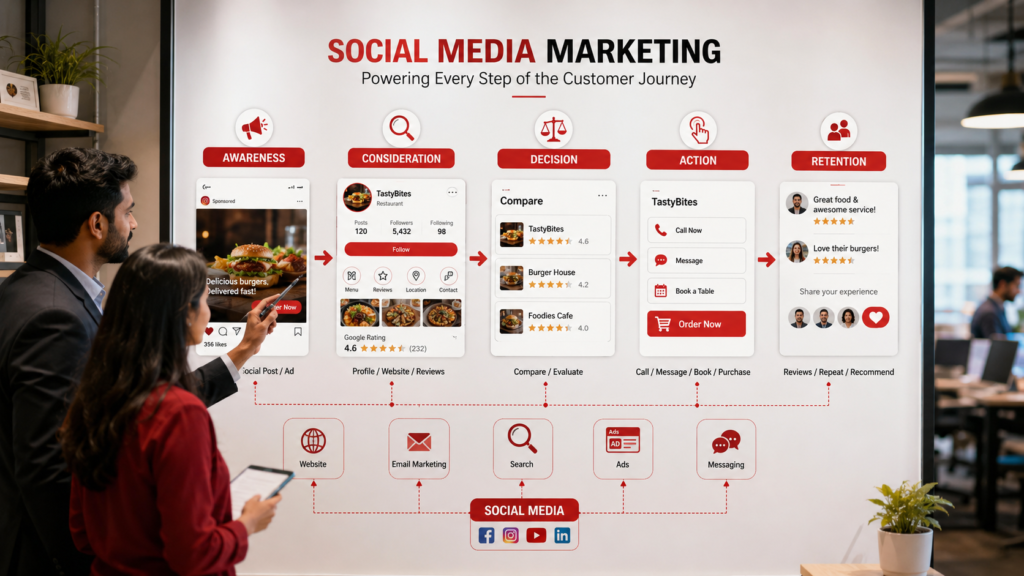
Social Media Marketing and the Customer Journey
Social media can influence customers at multiple stages of the buying journey.
Awareness
A potential customer discovers your business through a post, video, recommendation, or advertisement.
Consideration
They visit your profile, website, reviews, or other content to learn more.
Decision
They compare your business with competitors and evaluate your products, services, pricing, credibility, and customer experience.
Action
They call, message, book an appointment, request a quotation, visit your store, or make a purchase.
Retention
After becoming a customer, they may continue following your business, engage with your content, leave reviews, or recommend your business to others.
This is why social media should not be viewed only as an advertising platform. It can support the entire customer journey.
Integrating Social Media With Other Digital Marketing Channels
Social media works best when it is part of a larger digital marketing strategy.
For example:
SEO + Social Media:
SEO helps people discover your website through search engines, while social media can distribute content and strengthen brand visibility.
Google Ads + Social Media:
Search advertising can capture people actively looking for a product or service, while social media advertising can help introduce your business to potential customers.
Website + Social Media:
Your website can provide detailed information and conversion opportunities, while social media can drive interested users to the website.
Email Marketing + Social Media:
Social media can attract new audiences while email marketing can help nurture existing prospects and customers.
A connected digital marketing strategy can create a stronger customer acquisition system than relying on one channel alone.
How Small Businesses Can Get Started With Social Media Marketing
If your business is new to social media marketing, you do not need to build everything at once.
Start with a simple process:
- Define your business objective.
- Identify your ideal customer.
- Select the most relevant social media platforms.
- Create your content pillars.
- Develop a realistic content calendar.
- Publish useful and consistent content.
- Engage with your audience.
- Test paid advertising when appropriate.
- Track leads and conversions.
- Review performance and improve your strategy.
The key is consistency and continuous improvement.
Final Thoughts
Social media marketing for small businesses has become an important part of building visibility, trust, customer relationships, and business growth in 2026.
However, successful social media marketing is not simply about posting every day or collecting followers. It requires a clear understanding of your audience, consistent content, strong creative communication, strategic advertising, and continuous performance measurement.
Whether you operate a local shop, restaurant, clinic, educational institution, real estate company, professional service, or startup, social media can help you connect with the right audience and move potential customers closer to taking action.
The businesses that approach social media strategically not just as a place to post, but as part of their overall digital marketing system are better positioned to build a recognizable brand and generate sustainable growth.
If you want to grow your business online, start by understanding your audience, choosing the right platforms, creating valuable content, and measuring what actually contributes to business results. With the right strategy, social media can become more than a communication channel it can become an important part of your customer acquisition and growth engine.