Marketing is essential for every small business, but managing content, social media, advertising, customer communication, and analytics can be challenging with limited time and resources.
This is where Artificial Intelligence (AI) can make a difference.
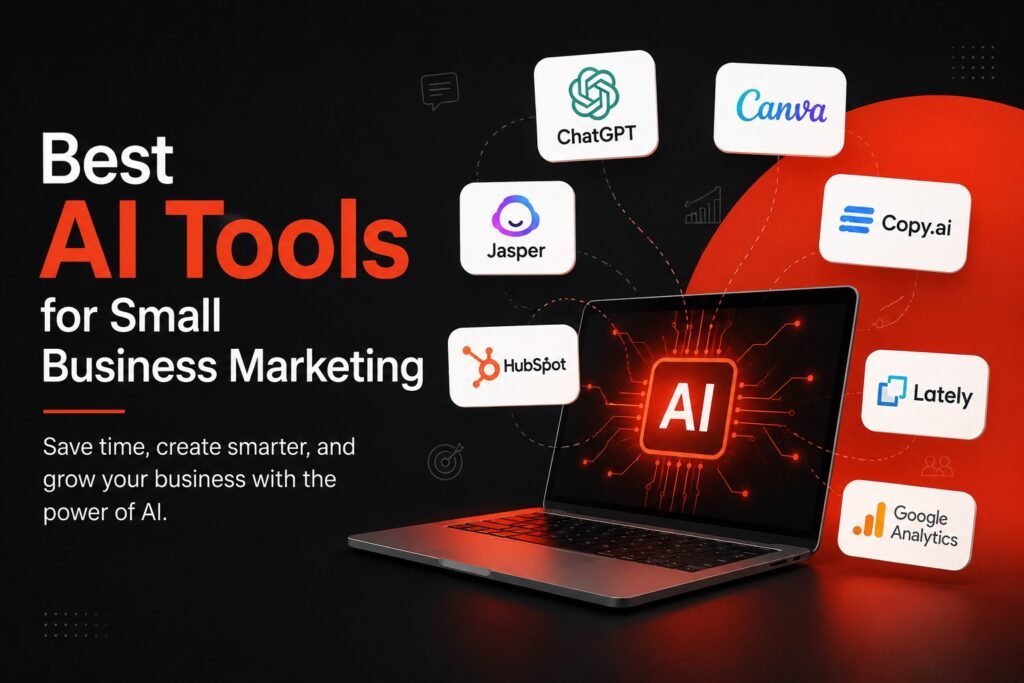
AI marketing tools can help small businesses generate content, create designs, analyze data, automate repetitive tasks, improve customer communication, and support marketing decisions. Instead of replacing marketers, these tools can help businesses work faster and focus more on strategy and creativity.
From creating social media posts to researching keywords and analyzing campaigns, the right AI tools can help small businesses build a more efficient marketing workflow.
In this guide, we’ll explore the best AI tools for small business marketing, what each tool can do, and how businesses can use them effectively.
Why Should Small Businesses Use AI for Marketing?
Small businesses often operate with limited budgets and small teams. Managing every aspect of marketing manually can take significant time.
AI can help automate and simplify many marketing activities, including:
- Content creation
- Social media marketing
- Graphic design
- SEO research
- Email marketing
- Customer support
- Advertising
- Data analysis
- Video creation
- Marketing automation
The biggest advantage isn’t simply saving time. AI can help small businesses produce more marketing output without significantly increasing workload.
However, AI works best when combined with human creativity, brand knowledge, and strategic decision-making.
1. ChatGPT – AI Assistant for Marketing Content
OpenAI’s ChatGPT can be useful for a wide range of small business marketing tasks.
Businesses can use AI assistants like ChatGPT to brainstorm ideas, create content drafts, summarize information, develop campaign concepts, and assist with customer-facing copy.
Marketing tasks you can use it for:
- Blog ideas
- Social media captions
- Ad copy
- Email drafts
- Product descriptions
- Content calendars
- Marketing strategies
- FAQ content
- Video scripts
- Keyword brainstorming
For example, a local salon could use AI to generate ideas for Instagram campaigns, promotional captions, and seasonal marketing content.
Best for:
Content planning, copywriting, brainstorming, and marketing assistance.
2. Canva – AI-Powered Design for Small Businesses
Canva combines traditional design tools with AI-powered features.
For small businesses that don’t have an in-house designer, Canva can make it easier to create professional marketing materials.
You can create:
- Social media posts
- Instagram stories
- Presentations
- Posters
- Flyers
- Advertisements
- Business cards
- YouTube thumbnails
- Marketing graphics
AI-powered features can also assist with generating design ideas, editing images, and creating content more efficiently.
Best for:
Social media design, branding, presentations, and marketing graphics.
3. Google Gemini – AI for Research and Ideas
Google’s Gemini can assist businesses with research, brainstorming, writing, and other productivity tasks.
Small businesses can use AI to help:
- Brainstorm campaign ideas
- Research topics
- Draft content
- Summarize information
- Create marketing concepts
- Organize ideas
- Develop customer FAQs
For businesses already using Google’s ecosystem, Gemini can also fit naturally into existing workflows depending on the available Google Workspace features and plan.
Best for:
Research, brainstorming, productivity, and content assistance.
4. Grammarly – AI Writing Assistant
Professional communication matters when you’re communicating with customers.
Grammarly can help businesses improve their written communication by identifying grammar, spelling, clarity, and tone issues.
Small businesses can use it when writing:
- Emails
- Website content
- Social media posts
- Advertisements
- Product descriptions
- Business proposals
- Customer messages
AI writing suggestions can help make communication clearer and more professional.
Best for:
Proofreading, editing, tone improvement, and business communication.
5. HubSpot – AI-Powered Marketing and CRM
HubSpot provides CRM, marketing, sales, and customer service tools.
Its AI features can assist businesses with activities such as content creation, customer relationship management, marketing automation, and sales workflows.
Small businesses can use a CRM to organize:
- Leads
- Customer information
- Sales activities
- Marketing campaigns
- Follow-ups
- Customer interactions
Instead of keeping customer information across spreadsheets and different applications, a CRM can provide a more organized system.
Best for:
CRM, lead management, marketing automation, and sales.
6. Semrush – AI and SEO Marketing Tools
Semrush is widely used for SEO and digital marketing research.
Small businesses can use SEO tools to research:
- Keywords
- Competitors
- Search rankings
- Backlinks
- Website performance
- Content opportunities
AI-powered features can also support content workflows and SEO research.
For example, a local business can research keywords related to its services and identify opportunities to create useful content.
Best for:
SEO research, keyword research, competitor analysis, and content strategy.
7. Buffer – AI for Social Media Marketing
Buffer helps businesses manage and schedule social media content.
Small businesses can use social media management tools to plan content across platforms and maintain a consistent publishing schedule.
AI features can assist with:
- Post ideas
- Caption creation
- Content repurposing
- Social media planning
- Content scheduling
Instead of creating and publishing posts randomly, businesses can develop a structured social media calendar.
Best for:
Social media planning, scheduling, and content management.
8. Mailchimp – AI-Assisted Email Marketing
Mailchimp is an email marketing platform that provides tools for creating campaigns, managing contacts, and automating communication.
AI-assisted features can help businesses create and improve email marketing campaigns.
Businesses can use email marketing for:
- Promotions
- Newsletters
- Product updates
- Customer follow-ups
- Abandoned cart campaigns
- Event announcements
For small businesses, automated email campaigns can help maintain relationships with existing customers.
Best for:
Email marketing, customer communication, and automation.
9. Adobe Firefly – AI for Creative Content
Adobe’s Firefly provides generative AI capabilities for creative workflows.
It can assist with creating and editing visual content for marketing and design projects.
Businesses can use AI-powered creative tools for:
- Concept development
- Image generation
- Image editing
- Creative variations
- Marketing visuals
However, businesses should always review AI-generated content carefully and ensure that it fits their brand identity.
Best for:
Creative concepts, image generation, and visual content workflows.
10. Meta AI Tools – Social Media and Advertising
Meta Platforms continues to introduce AI capabilities across its advertising and social media ecosystem.
For businesses running campaigns on Facebook and Instagram, AI-powered tools can assist with creative development, advertising workflows, and campaign optimization.
Small businesses can benefit from AI-assisted advertising while still monitoring:
- Cost per lead
- Click-through rate
- Conversion rate
- Return on ad spend
- Audience performance
AI can support optimization, but businesses should still understand where their advertising budget is going.
Best for:
Social media advertising, creative variations, and campaign optimization.
How to Choose the Right AI Marketing Tool
You don’t need ten different AI tools to improve your marketing.
The right tools depend on your business goals.
If you need content ideas:
Choose an AI writing assistant.
If you need social media designs:
Choose an AI-powered design platform.
If you need SEO:
Choose an SEO research and optimization platform.
If you need customer management:
Choose a CRM with AI capabilities.
If you need email automation:
Choose an email marketing platform.
If you need advertising support:
Use the AI capabilities available within your advertising platforms.
The goal should be to create a simple and efficient marketing technology stack rather than collecting as many tools as possible.
How Small Businesses Can Use AI Without Losing Their Brand Identity
One common mistake is publishing AI-generated content without reviewing it.
AI can produce content quickly, but it doesn’t automatically understand your:
- Brand personality
- Customers
- Local market
- Business experience
- Products
- Competitive advantages
That’s why human review is important.
A better process is:
AI generates → Human reviews → Brand edits → Business publishes
This approach combines the speed of AI with human creativity and expertise.
AI Marketing Tools vs Traditional Marketing
AI doesn’t necessarily replace traditional marketing.
Instead, it can make existing marketing processes more efficient.
For example:
| Marketing Task | Traditional Approach | AI-Assisted Approach |
|---|---|---|
| Content ideas | Manual brainstorming | AI-assisted brainstorming |
| Social captions | Write from scratch | AI draft + human editing |
| Design | Manual creation | AI-assisted design |
| SEO research | Manual analysis | AI-assisted research |
| Email campaigns | Manual creation | Templates + AI assistance |
| Customer data | Spreadsheets | CRM automation |
| Ad creatives | Multiple manual versions | AI-assisted variations |
| Reporting | Manual analysis | Automated insights |
The best results usually come from combining both approaches.
Important Things to Consider Before Using AI
AI tools can be powerful, but businesses should use them responsibly.
Don’t publish everything AI generates
Always review content for accuracy, tone, and originality.
Protect customer information
Don’t enter sensitive or confidential customer information into AI tools unless you understand how that platform handles the data.
Maintain brand consistency
Your website, social media, advertisements, and emails should have a consistent voice.
Check facts
AI can sometimes generate incorrect or outdated information. Important business, financial, legal, medical, or technical claims should be independently verified.
Don’t sacrifice creativity
AI should support your marketing team—not make every piece of content look identical.
A Simple AI Marketing Workflow for Small Businesses
You don’t need a complicated system to get started.
A simple workflow could look like this:
Step 1: Research
Use SEO and research tools to identify customer interests and search opportunities.
Step 2: Plan
Use AI to brainstorm content ideas and create a monthly content calendar.
Step 3: Create
Use AI writing and design tools to create initial drafts and creative concepts.
Step 4: Review
Check every piece of content for accuracy, originality, brand consistency, and relevance.
Step 5: Publish
Publish content through your website, social media platforms, email campaigns, or advertising channels.
Step 6: Analyze
Review performance data and identify what’s working.
Step 7: Improve
Use those insights to improve your next campaign.
This creates a continuous marketing cycle:
Research → Plan → Create → Publish → Analyze → Improve
Final Thoughts
AI is changing the way small businesses approach marketing.
From content creation and graphic design to SEO, social media management, CRM, email marketing, and advertising, AI tools can help businesses save time and improve their marketing workflows.
However, the best AI tool isn’t necessarily the one with the most features.
The right tool is the one that solves a real business problem and fits into your existing workflow.
Start with one or two tools, learn how they can improve your processes, and gradually build an AI-powered marketing system around your business.
Most importantly, remember that successful marketing still depends on understanding your customers, creating valuable content, building trust, and delivering a strong customer experience.
AI can make marketing faster. Your strategy makes it effective.