
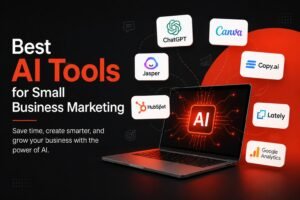
Best AI Tools for Small Business Marketing
Marketing is essential for every small business, but managing content, social media, advertising, customer communication, and analytics can be challenging with limited time and resources. This is where Artificial Intelligence (AI) can make a difference. AI marketing tools can help small businesses generate content, create designs, analyze data, automate repetitive tasks, improve customer communication, and support marketing decisions. Instead of replacing marketers, these tools can help businesses work faster and focus more on strategy and creativity. From creating social media posts to researching keywords and analyzing campaigns, the right AI tools can help small businesses build a more efficient marketing workflow. In this guide, we’ll explore the best AI tools for small business marketing, what each tool can do, and how businesses can use them effectively. Why Should Small Businesses Use AI for Marketing? Small businesses often operate with limited budgets and small teams. Managing every aspect of marketing manually can take significant time. AI can help automate and simplify many marketing activities, including: The biggest advantage isn’t simply saving time. AI can help small businesses produce more marketing output without significantly increasing workload. However, AI works best when combined with human creativity, brand knowledge, and strategic decision-making. 1. ChatGPT – AI Assistant for Marketing Content OpenAI’s ChatGPT can be useful for a wide range of small business marketing tasks. Businesses can use AI assistants like ChatGPT to brainstorm ideas, create content drafts, summarize information, develop campaign concepts, and assist with customer-facing copy. Marketing tasks you can use it for: For example, a local salon could use AI to generate ideas for Instagram campaigns, promotional captions, and seasonal marketing content. Best for: Content planning, copywriting, brainstorming, and marketing assistance. 2. Canva – AI-Powered Design for Small Businesses Canva combines traditional design tools with AI-powered features. For small businesses that don’t have an in-house designer, Canva can make it easier to create professional marketing materials. You can create: AI-powered features can also assist with generating design ideas, editing images, and creating content more efficiently. Best for: Social media design, branding, presentations, and marketing graphics. 3. Google Gemini – AI for Research and Ideas Google’s Gemini can assist businesses with research, brainstorming, writing, and other productivity tasks. Small businesses can use AI to help: For businesses already using Google’s ecosystem, Gemini can also fit naturally into existing workflows depending on the available Google Workspace features and plan. Best for: Research, brainstorming, productivity, and content assistance. 4. Grammarly – AI Writing Assistant Professional communication matters when you’re communicating with customers. Grammarly can help businesses improve their written communication by identifying grammar, spelling, clarity, and tone issues. Small businesses can use it when writing: AI writing suggestions can help make communication clearer and more professional. Best for: Proofreading, editing, tone improvement, and business communication. 5. HubSpot – AI-Powered Marketing and CRM HubSpot provides CRM, marketing, sales, and customer service tools. Its AI features can assist businesses with activities such as content creation, customer relationship management, marketing automation, and sales workflows. Small businesses can use a CRM to organize: Instead of keeping customer information across spreadsheets and different applications, a CRM can provide a more organized system. Best for: CRM, lead management, marketing automation, and sales. 6. Semrush – AI and SEO Marketing Tools Semrush is widely used for SEO and digital marketing research. Small businesses can use SEO tools to research: AI-powered features can also support content workflows and SEO research. For example, a local business can research keywords related to its services and identify opportunities to create useful content. Best for: SEO research, keyword research, competitor analysis, and content strategy. 7. Buffer – AI for Social Media Marketing Buffer helps businesses manage and schedule social media content. Small businesses can use social media management tools to plan content across platforms and maintain a consistent publishing schedule. AI features can assist with: Instead of creating and publishing posts randomly, businesses can develop a structured social media calendar. Best for: Social media planning, scheduling, and content management. 8. Mailchimp – AI-Assisted Email Marketing Mailchimp is an email marketing platform that provides tools for creating campaigns, managing contacts, and automating communication. AI-assisted features can help businesses create and improve email marketing campaigns. Businesses can use email marketing for: For small businesses, automated email campaigns can help maintain relationships with existing customers. Best for: Email marketing, customer communication, and automation. 9. Adobe Firefly – AI for Creative Content Adobe’s Firefly provides generative AI capabilities for creative workflows. It can assist with creating and editing visual content for marketing and design projects. Businesses can use AI-powered creative tools for: However, businesses should always review AI-generated content carefully and ensure that it fits their brand identity. Best for: Creative concepts, image generation, and visual content workflows. 10. Meta AI Tools – Social Media and Advertising Meta Platforms continues to introduce AI capabilities across its advertising and social media ecosystem. For businesses running campaigns on Facebook and Instagram, AI-powered tools can assist with creative development, advertising workflows, and campaign optimization. Small businesses can benefit from AI-assisted advertising while still monitoring: AI can support optimization, but businesses should still understand where their advertising budget is going. Best for: Social media advertising, creative variations, and campaign optimization. How to Choose the Right AI Marketing Tool You don’t need ten different AI tools to improve your marketing. The right tools depend on your business goals. If you need content ideas: Choose an AI writing assistant. If you need social media designs: Choose an AI-powered design platform. If you need SEO: Choose an SEO research and optimization platform. If you need customer management: Choose a CRM with AI capabilities. If you need email automation: Choose an email marketing platform. If you need advertising support: Use the AI capabilities available within your advertising platforms. The goal should be to create a simple and efficient marketing technology stack rather than collecting as many tools as possible. How Small Businesses Can Use AI Without Losing Their Brand Identity One common mistake is publishing AI-generated content without