
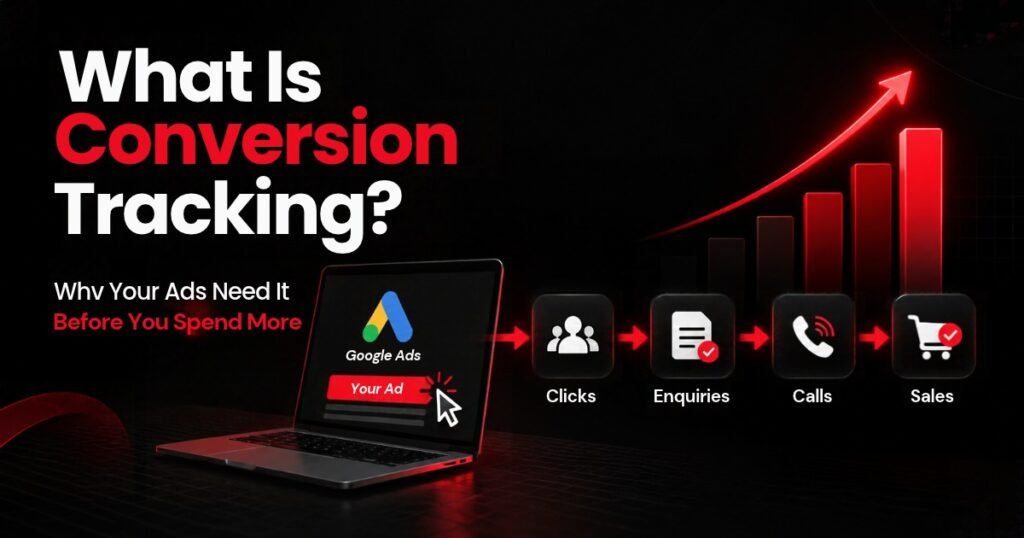
You are running Google Ads, getting clicks, and spending money every month. But do you know how many of those clicks actually turn into enquiries, calls, bookings, or customers? Conversion tracking helps answer that question. Instead of looking only at clicks and impressions, you can see which actions from your ads are actually helping your business.
What Is Conversion Tracking and Why Does It Matter?
Conversion tracking is the process of measuring valuable actions people take after interacting with your advertisement. These actions can include submitting a form, making a purchase, calling your business, requesting a quote, or booking a service.
For example, imagine you are running Google Ads for a real estate project. Your campaign receives 200 clicks, but only 15 people submit an enquiry. Without proper tracking, you may only see those 200 clicks and assume the campaign is performing well.
However, conversion tracking gives you a clearer picture of what happens after those clicks.
Why Are Clicks Alone Not Enough?
Clicks can show that people are interested in your advertisement. However, they do not always mean that people are interested in buying from you.
Consider two campaigns:
Campaign A:
300 clicks → 8 enquiries
Campaign B:
150 clicks → 20 enquiries
At first, Campaign A may look better because it received more clicks. However, Campaign B is generating more enquiries with fewer clicks.
Therefore, looking only at clicks can lead to the wrong decision.
What Should Your Business Track with conversion Tracking?
Every business can have different conversion goals.
For example, a real estate company may want to track:
- Enquiry forms
- Phone calls
- Site-visit requests
Similarly, an e-commerce business may focus on:
- Purchases
- Add-to-cart actions
- Completed checkouts
For a service business, useful conversions could include contact forms, WhatsApp enquiries, calls, and appointment bookings.
The key is to track actions that have real value for your business.
How Does Conversion Tracking Improve Your Ads?
Once Google Ads conversion tracking is set up correctly, your advertising data becomes much more useful.
You can then identify which campaigns generate enquiries, which keywords bring valuable visitors, and which ads are not producing meaningful results.
As a result, you can make better decisions about where to use your advertising budget.
Google also uses conversion data to help optimise certain campaigns and bidding strategies. This makes accurate conversion tracking important not only for reporting, but also for campaign optimisation.
What Happens When Ads Are Not Tracked?
Without proper tracking, you may know how much you spent and how many people clicked your ads. However, you may not know what happened after those clicks.
As a result, you could increase the budget of a campaign that gets many clicks but very few enquiries.
At the same time, another campaign might generate better leads but receive less budget because its results are not being measured properly.
How To Check Your Conversion Tracking Before Spending More?
Before increasing your advertising budget, check whether:
- Your important conversions are being tracked
- Phone calls are measured
- Enquiry forms are recorded correctly
- Campaign results are connected to conversions
- You can identify which ads generate enquiries
Most importantly, make sure your tracking reflects the actions that actually matter to your business.
Final Takeaway
Clicks tell you that someone interacted with your advertisement. Conversions tell you whether that interaction created a valuable business action.
Therefore, before spending more on Google Ads, make sure you know what your advertising is actually producing.
At VONE Digitals, we help businesses build measurable digital marketing campaigns that focus not only on clicks, but also on the actions that contribute to real business growth.
Don’t just ask how many people clicked. Ask what happened after the click.